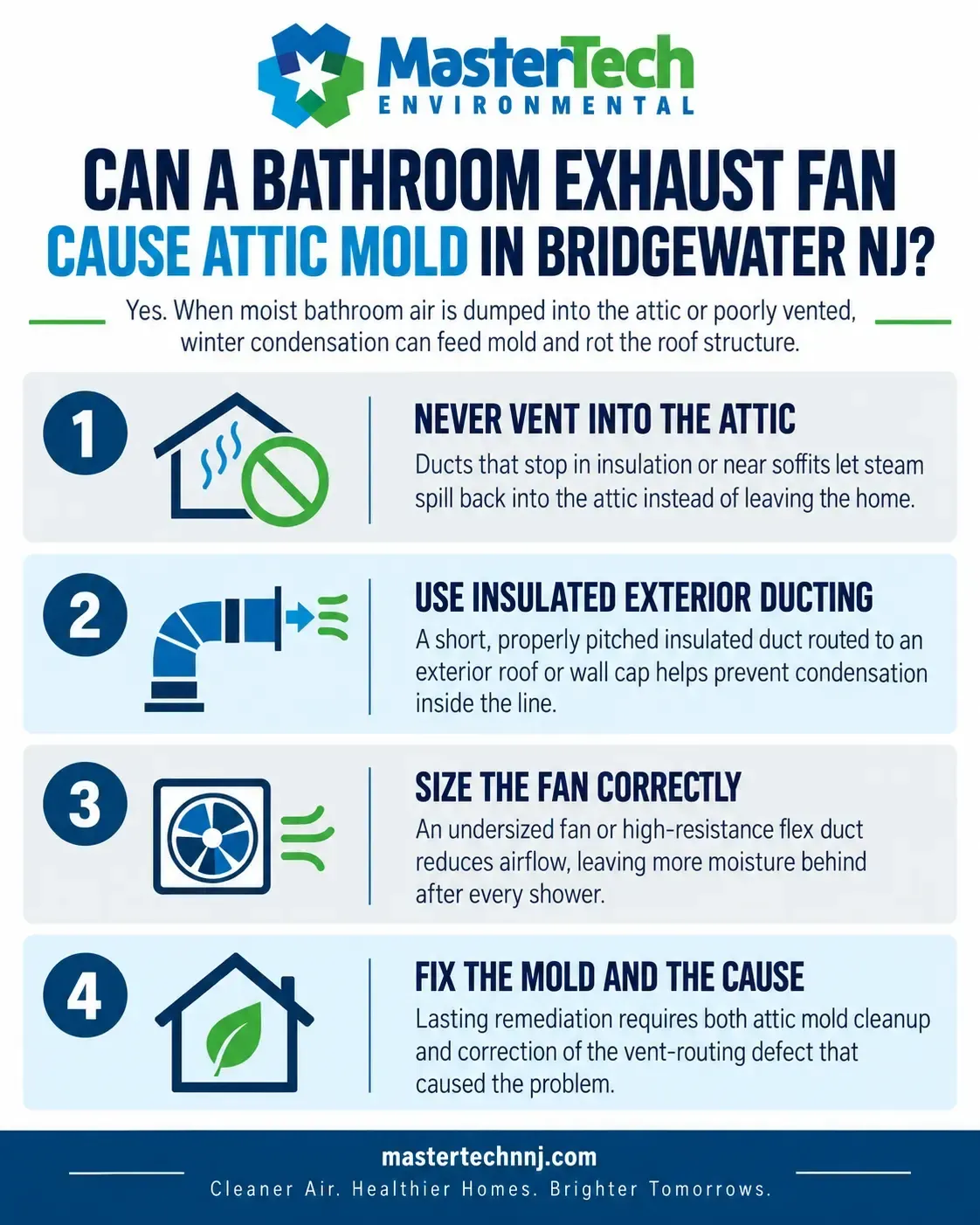
Can a Bathroom Exhaust Fan Cause Attic Mold in Bridgewater NJ?
The Winter Condensation Trap in Somerset County Attics
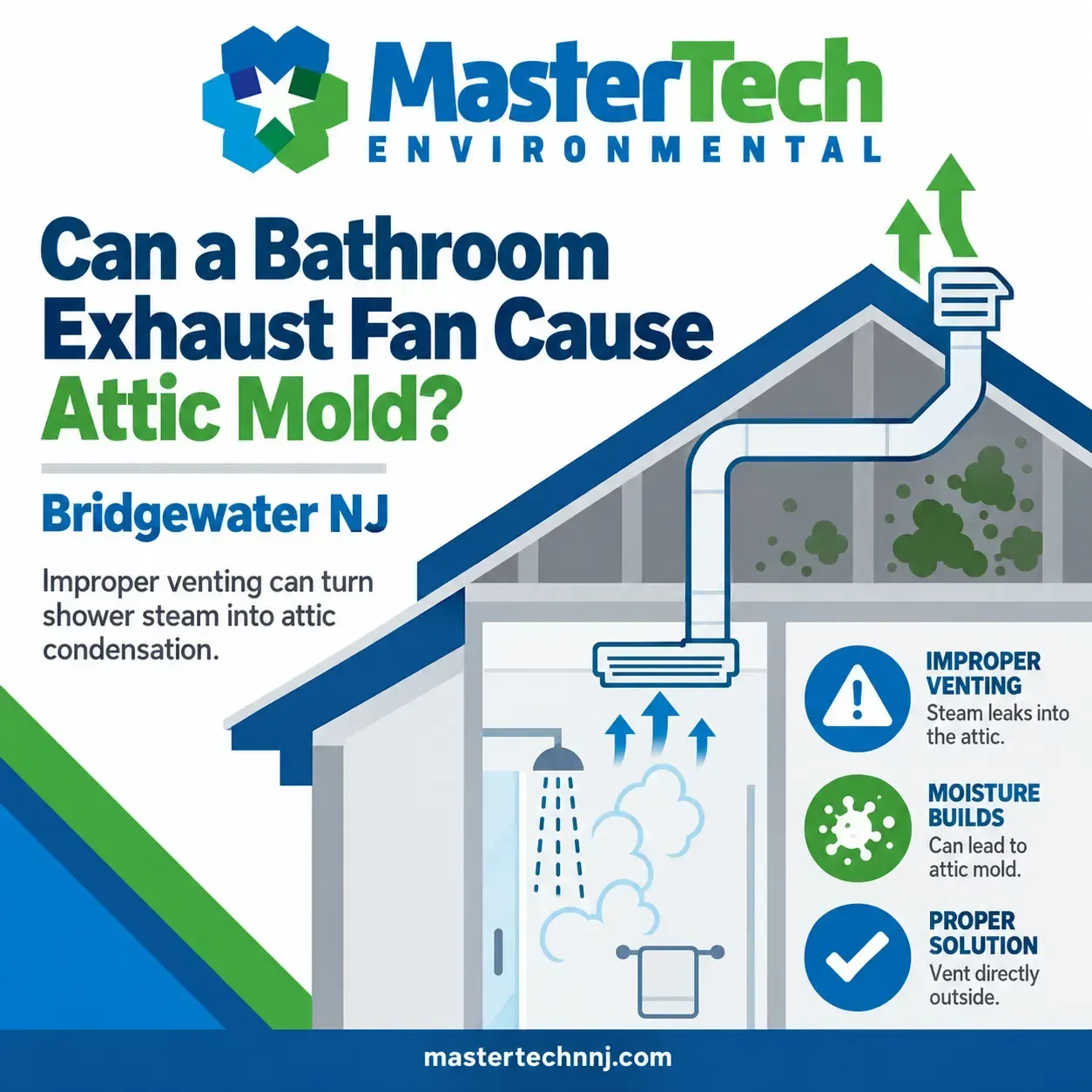
During a freezing New Jersey winter, when outdoor temperatures drop well below freezing, homeowners in Somerset County rely heavily on hot showers to start their day. When investigating the source for mold remediation Bridgewater NJ, one of the most surprising culprits uncovered in residential attics is an improperly installed bathroom exhaust fan. What seems like a minor ventilation shortcut—ductwork that terminates directly into the attic or blows against an unsealed soffit vent—can dump hundreds of gallons of concentrated steam directly onto cold roof sheathing, triggering massive black mold growth across roof rafters and plywood.
In many split-level, colonial, and ranch homes across Bridgewater, builders or previous contractors took the path of least resistance by laying flexible foil ducting across attic insulation without penetrating the roof. When hot, saturated bathroom air enters an unconditioned attic where the roof decking is 20 degrees, the moisture instantly turns into liquid water, turning your attic into an icehouse in winter and a mold incubator come spring.
The Thermodynamics of Attic Decking Moisture Condensation
A standard ten-minute shower generates nearly two pints of pure water vapor. In an active household with four family members showering daily, that adds up to over fifty gallons of airborne water every single month.
When that moisture has no direct path outdoors, the following occurs:
- The 'Dead-End' Duct Termination: Ductwork simply dumped into blown-in insulation saturates fiberglass, compresses insulation, and causes ceiling drywall below to rot.
- The Soffit Blow-Back Flaw: Pointing a duct at a perforated soffit vent fails because natural attic ventilation dynamics pull air in through soffits, blowing moist exhaust right back into the attic.
- Uninsulated Duct Condensation: Hot steam moving through uninsulated flexible ducting condenses inside the pipe itself, forming heavy water pockets that collapse the duct or leak through ceiling penetrations.
During prolonged cold snaps, this moisture freezes against the underside of roof sheathing as a thick layer of frost. When warmer weather arrives, that frost melts rapidly, raining down on attic insulation and creating ideal conditions for Cladosporium and Aspergillus to blanket roof decking in solid black growth.
The Micro-Climate of North-Facing Roof Slopes
In Bridgewater homes, attic mold inspection reveals a consistent architectural pattern: microbial growth is almost always most severe along the north-facing roof slope. While south-facing slopes receive direct sunlight that warms the roof sheathing and evaporates residual moisture, the north slope remains in freezing shade throughout winter.
When moist bathroom exhaust drifts into the attic, it naturally migrates toward the coldest surfaces available. The sub-freezing plywood on the north slope acts as a continuous thermal magnet for water vapor, developing dense layers of frost that thaw into standing water droplets. This localized micro-climate explains why one side of an attic roof can look clean while the opposite side is completely blackened with fungal colonies.
Fan Sizing, Duct Resistance, and Static Pressure Dynamics
Many attic mold problems are aggravated by builder-grade bathroom exhaust fans that lack sufficient power. A standard 50-CFM (cubic feet per minute) fan is barely adequate for a small powder room. When paired with long runs of corrugated flexible foil ducting, the fan's actual airflow drops dramatically.
Flexible ribbed ducting creates intense static friction, cutting effective airflow by up to fifty percent compared to smooth metal pipe. Furthermore, every 90-degree elbow in the duct run adds the equivalent of ten to fifteen feet of straight resistance. In many Bridgewater homes, by the time air reaches the end of an uninsulated flexible line, velocity has plummeted to a standstill, causing hot shower steam to condense inside the pipe and pool into heavy water sags that eventually rupture.
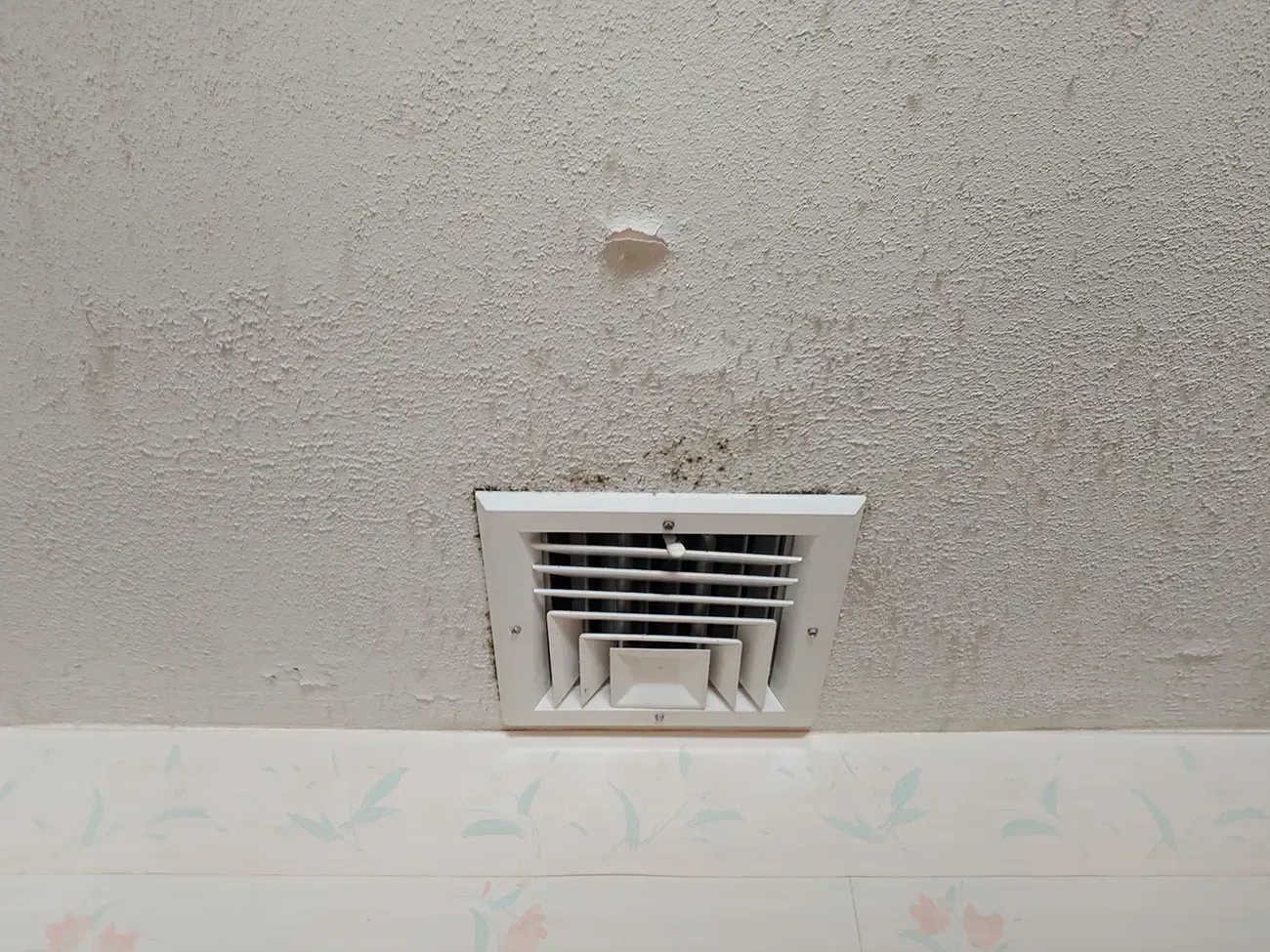
The Structural Cost: How Attic Condensation Rots Roof Sheathing and Nails
Attic mold is never an isolated cosmetic issue; it represents active structural decay. Galvanized roofing nails hold the underside of plywood or oriented strand board (OSB) roof sheathing in place. Continuous exposure to high condensation causes these nails to rust aggressively from the inside out, leading to 'shingle nail pop' and severe roof vulnerability during high wind events.
Furthermore, as wood-decay fungi feed on the cellulose glues holding plywood laminates together, the roof sheathing delaminates and softens. Homeowners often discover this damage only when a roofing contractor steps onto the roof and their foot pushes directly through spongy, rotted decking.
Comparing Improper Attic Venting with Dedicated Exterior Roof Discharge
| Ventilation Feature |
Improper Interior Attic Fan Venting |
Code-Compliant Exterior Roof Penetration |
| Exhaust Destination |
Dumped into open attic air or unsealed soffit bays |
Discharged directly outside through flashed metal roof cap |
| Ductwork Specification |
Uninsulated, ribbed flexible vinyl or foil ducting |
Smooth, rigid galvanized metal or R-8 insulated ducting |
| Backdraft Protection |
Missing or jammed flap; cold attic air drafts into bathroom |
Weighted exterior backdraft damper prevents reverse airflow |
| Roof Sheathing Impact |
Black mold colonies, rusted roofing nails, and wood rot |
Roof decking remains bone-dry and structurally sound year-round |
| Home Resale Valuation |
Red-flagged by home inspectors, requiring costly emergency remediation |
Passes real estate building inspections with zero complications |
| Indoor Spore Migration |
Spreading spores down into upper bedrooms through ceiling gaps |
Total isolation; bathroom air completely vented away from the home |
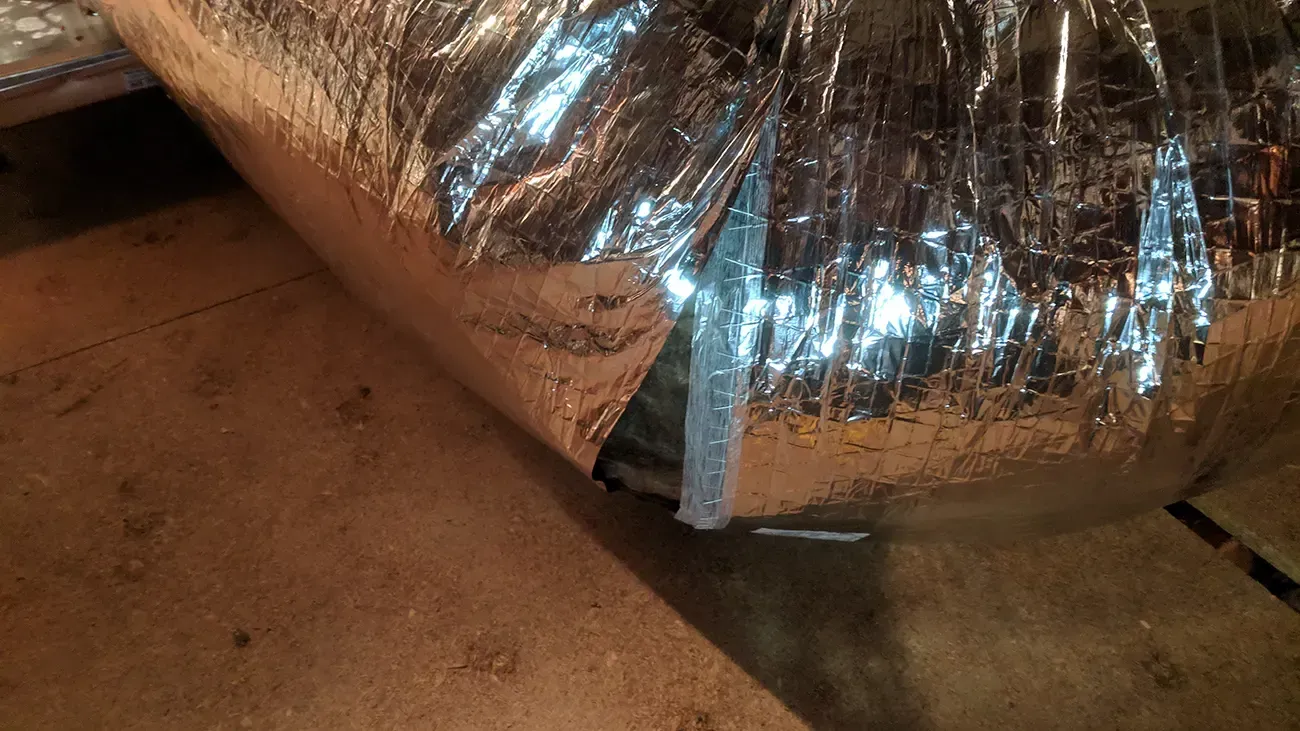
How Attic Contamination Migrates Downward into Living Areas
Many homeowners assume that attic mold poses little health risk because the space is rarely visited. However, warm air currents, whole-house fans, and air pressure imbalances cause attic air to migrate downward.
- Recessed Lighting Fixtures: Unsealed can lights in upper hallway and bedroom ceilings create direct vacuum pathways pulling attic air into bedrooms.
- Attic Pull-Down Stairs: Gaps around uninsulated attic hatch covers allow microscopic spores to drift into second-floor corridors whenever doors open.
- HVAC Duct Leakage: If your central air handler or flex ducting runs through the attic, negative pressure around return plenums sucks contaminated attic air into your air supply.
Professional Attic Remediation and Corrective Duct Re-Routing
Remediating attic mold requires far more than spraying a bleach solution or painting white primer over black rafters. Fungal root systems embedded in porous roof decking must be physically removed.
Under full HEPA negative air containment, certified specialists clean affected sheathing and rafters using abrasive media blasting or HEPA vacuuming with wire brushing. All surfaces are treated with EPA-registered antimicrobial solutions and sealed with a breathable, moisture-resistant fungal deterrent.
Crucially, the root ventilation defect must be corrected. Technicians install dedicated R-8 insulated ductwork pitched toward the roof penetration to prevent condensation drainage, terminating through a properly flashed, damper-equipped roof or gable cap that vents steam directly outside.
Protecting Your Bridgewater Roof and Indoor Air Quality
A bathroom exhaust fan is designed to protect your home from excess moisture, but when installed improperly, it becomes an engine for attic mold and structural roof decay. In our cold New Jersey climate, letting shower steam vent into your roof rafters puts both your roof's lifespan and your family's health at risk.
If you suspect attic moisture or notice darkened roof decking around exhaust lines, schedule a professional attic mold assessment today. Certified remediation combined with proper exterior duct routing will eliminate fungal contamination, protect your roof warranty, and keep your Bridgewater home healthy for years to come.