Why Do Finished Basements in Older Morristown NJ Homes Grow Mold?
The Conflict Between Historic Masonry and Modern Finished Spaces
Morristown is celebrated for its rich architectural heritage, featuring stately colonial residences, ornate Victorians, and solid mid-century homes. For homeowners seeking reliable mold remediation Morristown NJ, one of the most frequent structural challenges arises when an older basement is finished into a modern family room, home gym, or children's playroom. While finished basements add valuable living space, the construction methods often used directly clash with the physics of older North Jersey foundation masonry, creating a concealed moisture trap where toxic mold colonies thrive unseen.
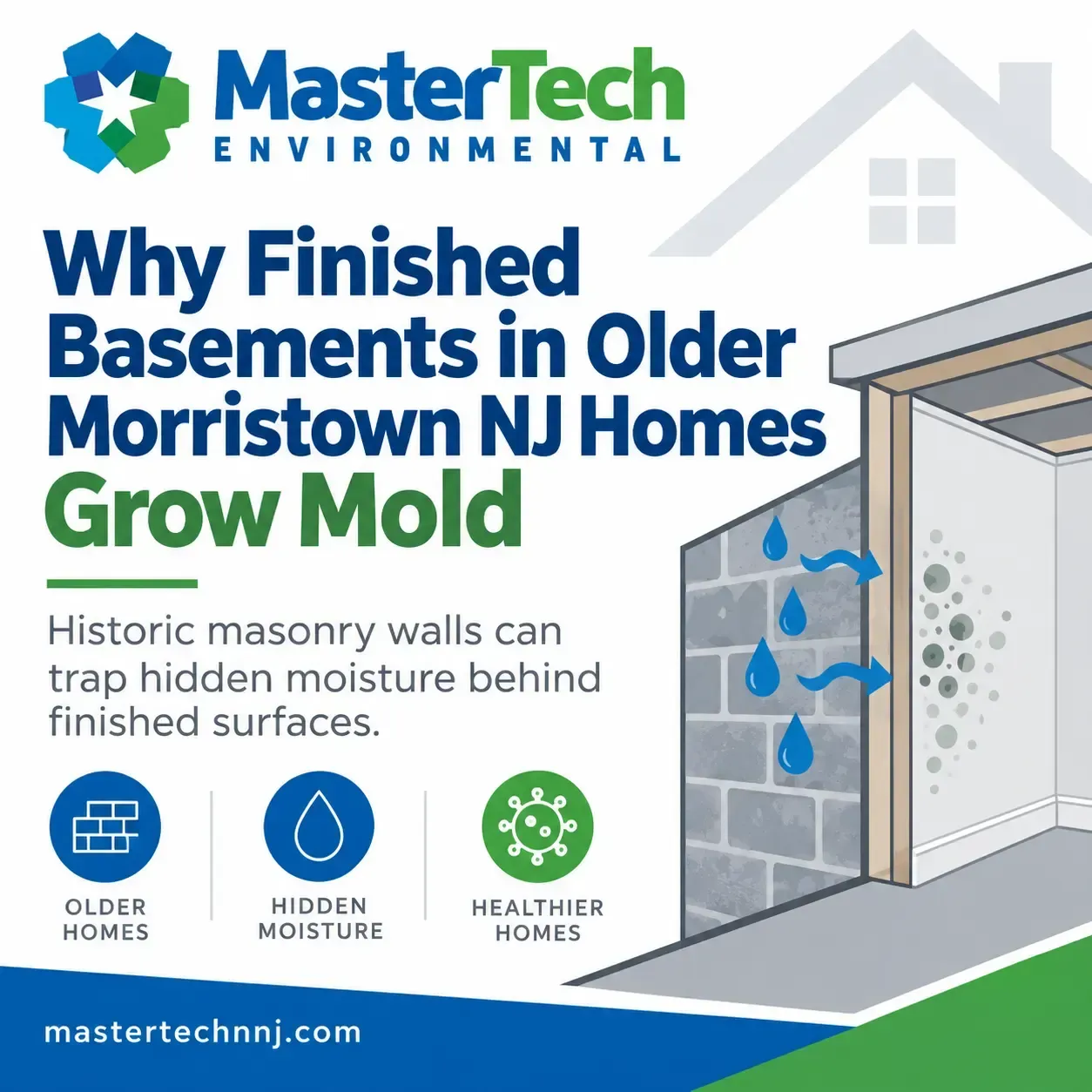
Basements built in the late 19th and early 20th centuries were never intended to be living spaces; they were designed as cool, breathable utility areas. When older fieldstone, rubble stone, or porous cinder block foundations are framed over with modern wooden studs, fiberglass insulation, and paper-faced drywall, natural foundation vapor migration is suddenly blocked, triggering aggressive microbial amplification behind the walls.
The Masonry Science of Historic Morris County Foundations
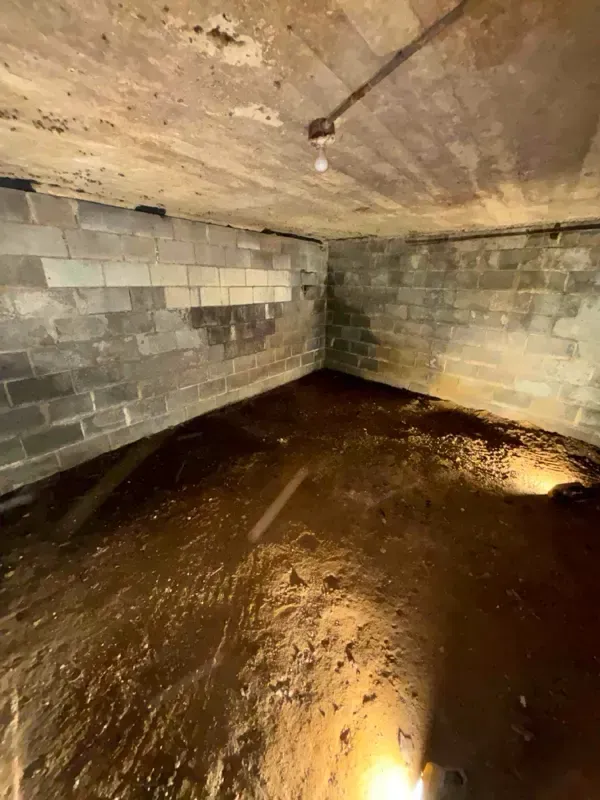
The soil throughout Morris County contains significant clay content, which expands and holds tremendous volumes of groundwater during wet New Jersey springs and autumns. This groundwater creates continuous hydrostatic pressure against subterranean foundation walls. Historic builders built fieldstone and lime mortar foundations to let moisture vaporize into open cellar air and escape through natural drafts.
When modern contractors attempt to waterproof these walls by applying thick coatings of impermeable waterproofing paint (such as masonry sealers) directly over interior stone, they inadvertently cause immense structural harm. Water trapped within the wall cannot escape; instead, it dissolves the lime binder in historic mortar, turning the mortar into soft sand. Meanwhile, water that forces its way past the coating pools behind finished drywall studs, feeding massive hidden mold blooms.
Understanding Hydrostatic Pressure and Capillary Vapor Drive
Moisture moves through older foundation walls through three distinct physical mechanisms.
- Capillary Suction: Liquid groundwater is pulled into microscopic pores within stone, concrete block, and mortar joints, climbing vertically and horizontally through walls like water in a paper towel.
- Hydrostatic Water Table Pressure: Heavy seasonal rains saturate Morris County clay soils, press against foundation exteriors, and force water through hairline cracks and joint seams.
- Vapor Drive and Thermal Condensation: Subterranean earth temperatures remain around 55 degrees Fahrenheit year-round. When warm, humid basement living air contacts the cold masonry behind finished drywall, moisture condenses on the cold side of insulation batts.
Because the finished drywall conceals the masonry, homeowners often live for years with massive colonies of Aspergillus, Penicillium, or Stachybotrys growing silently just inches away from where their children play or where they spend hours exercising.
Comparing Historic Foundation Masonry with Modern Sub-Grade Finishing
| Structural Parameter |
Historic Masonry Design (Fieldstone/Mortar) |
Flawed Modern Retrofit Finishing |
| Original Engineering Goal |
Breathable subterranean utility storage |
Airtight, conditioned, carpeted living space |
| Moisture Management |
Allows vapor to enter and evaporate naturally into open air |
Traps moisture behind vapor barriers and fiberglass batts |
| Vulnerability to Fungi |
Low; bare stone and lime mortar offer zero organic food |
Extreme; wood studs and paper drywall provide abundant nutrients |
| Air Quality Impact |
Damp odors confined to unfinished utility basement |
HVAC returns pull mycotoxins into upstairs living areas |
| Remediation Approach |
Simple surface masonry drying and exterior drainage |
Demolition of finished walls, stud decontamination, and antimicrobial seal |
| Long-Term Durability |
Stone and mortar remain stable for over a century |
Drywall and wood studs deteriorate within 3 to 7 years of finishing |
The Destructive Cycle of Trapped Salts: Efflorescence and Spalling
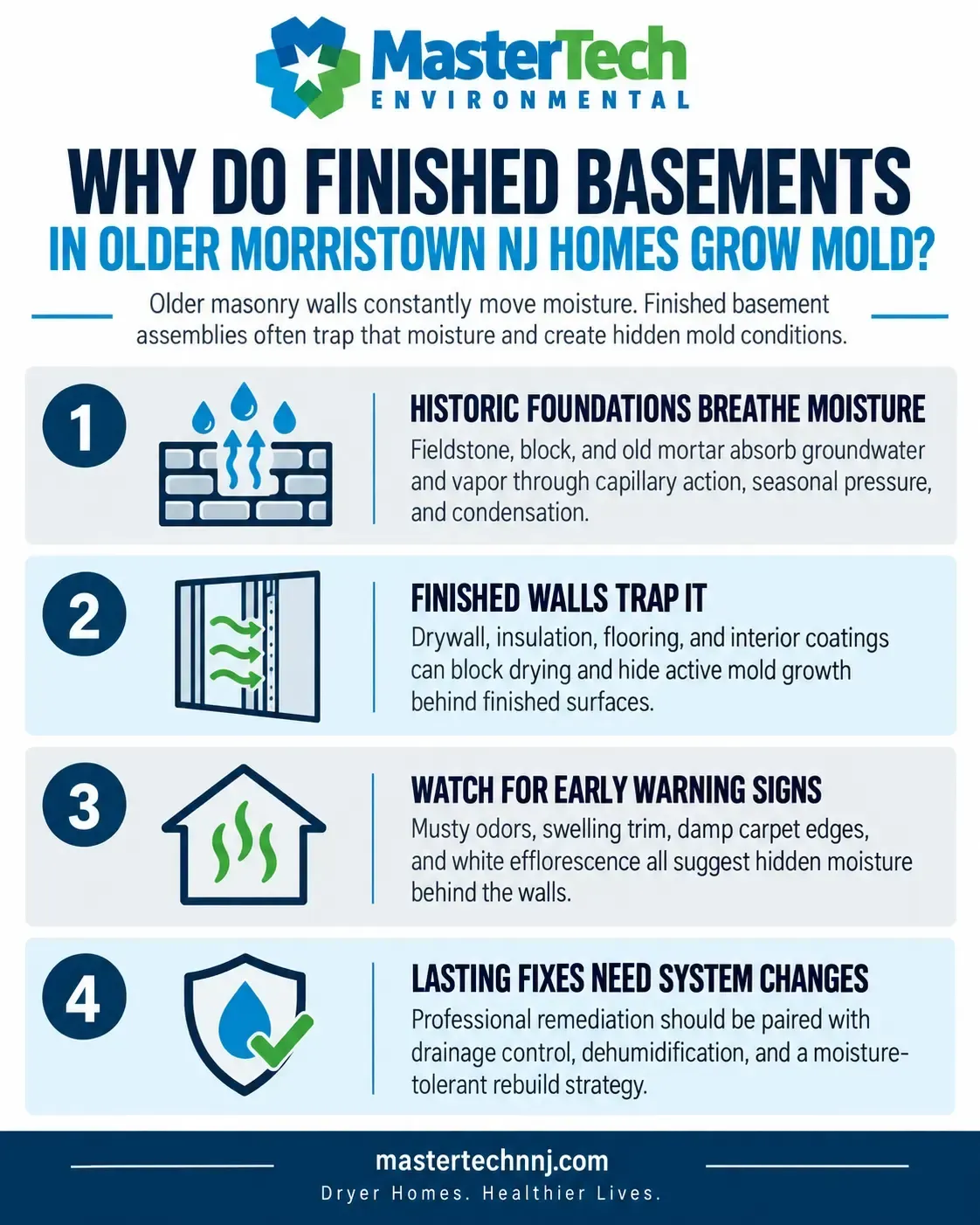
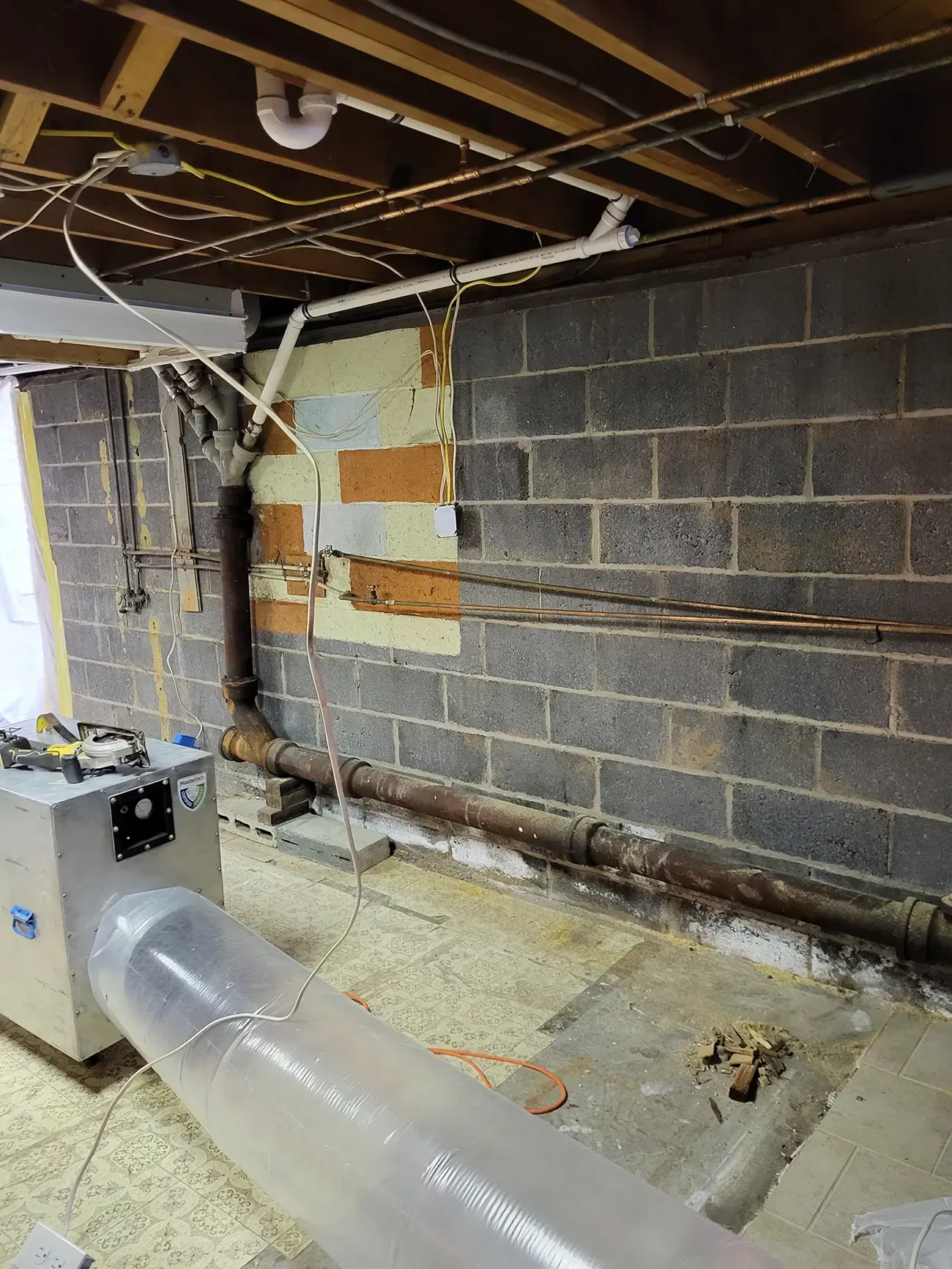
A key forensic indicator in older Morristown basements is white, powdery deposits known as efflorescence. As groundwater passes through foundation stones and mortar, it dissolves naturally occurring mineral salts. When that water evaporates, salt crystals are left behind on the masonry surface.
When an impermeable vapor barrier or waterproofing sealant covers the wall, these salts crystallize beneath the surface in a process known as subflorescence or cryptoflorescence. Crystallizing salts expand with tremendous hydraulic pressure—often exceeding 8,000 to 10,000 pounds per square inch. This internal force fractures the face of fieldstone. It causes older concrete blocks to crumble (spall), permanently compromising your foundation's structural integrity while creating a damp rubble bed where mold flourishes.
Telltale Signs of Hidden Basement Mold in Morristown Homes
Homeowners should never wait for visible black spots on the face of their drywall to investigate. If your finished basement exhibits any of these indicators, moisture is actively accumulating behind the walls.
- Baseboard Swelling or Carpet Tack Strip Decay: Moisture traveling down interior studs pools along the floor track, causing baseboards to warp and carpet edges to develop dark mold lines.
- A Heavy, Persistent Earthy Odor: A damp, mushroom-like smell that lingers even when commercial dehumidifiers run continuously indicates active fungal respiration in wall cavities.
- White Efflorescence on Exposed Foundation Sections: In unfinished utility corners, chalky white mineral deposits leaching through stone or block confirm heavy groundwater migration through the wall.
Certified Remediation and Corrective Sub-Grade Engineering
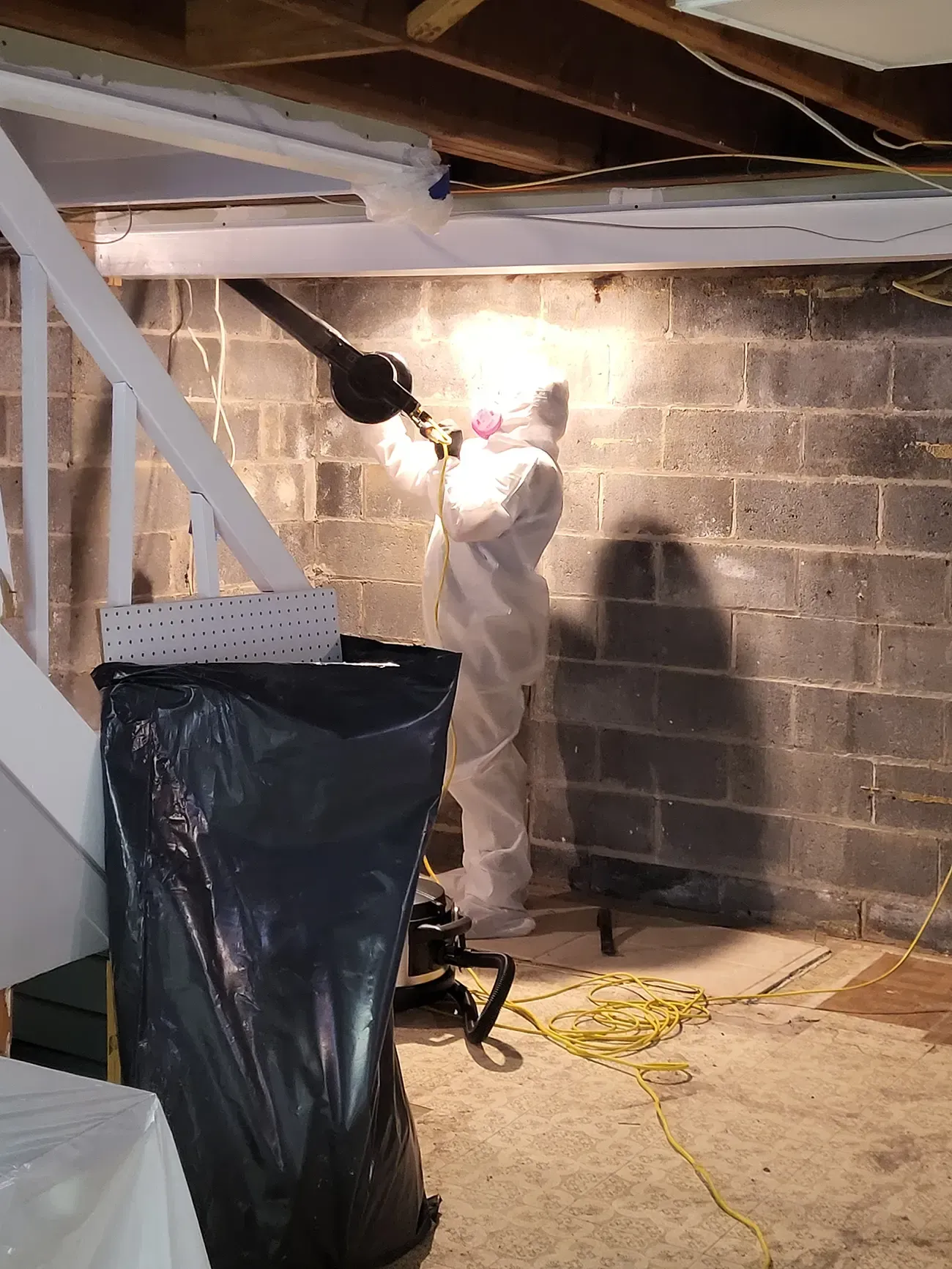
Spraying bleach on the front of drywall or running an ozone machine will not resolve basement mold in an older Morristown home. The only lasting solution requires professional IICRC S520 remediation protocols. Certified technicians construct critical containment chambers using six-mil poly sheeting placed under negative air pressure with commercial HEPA air scrubbers. This prevents microscopic mycotoxins and spores from escaping up the basement stairwell into upper-floor kitchens and living areas during demolition. Contaminated drywall, rotted baseboards, and wet fiberglass batt insulation are surgically removed, sealed in heavy disposal bags, and extracted from the home.
Exposed foundation masonry and structural floor joists are treated using mechanical abrasive cleaning—such as dry ice blasting or HEPA vacuuming with aggressive wire brushing—to physically extract embedded fungal hyphae from mortar joints and timber grain. All surfaces are then treated with an EPA-registered penetrating antimicrobial wash that inhibits future germination.
When rebuilding, homeowners must abandon flawed traditional methods for moisture-resilient engineering. A perimeter interior French drain tied to a dual-pump sump pit with battery backup manages bulk groundwater hydrostatic pressure. Rather than framing directly against stone, installers mount continuous two-inch closed-cell extruded polystyrene (XPS) rigid foam boards against the foundation with taped seams, creating an unbroken thermal break and vapor retarder. Light-gauge steel studs or treated lumber are positioned two inches off the foam, finished with mold-resistant, paperless gypsum board, and supported by a dedicated commercial low-temperature dehumidifier plumbed for continuous drainage.